
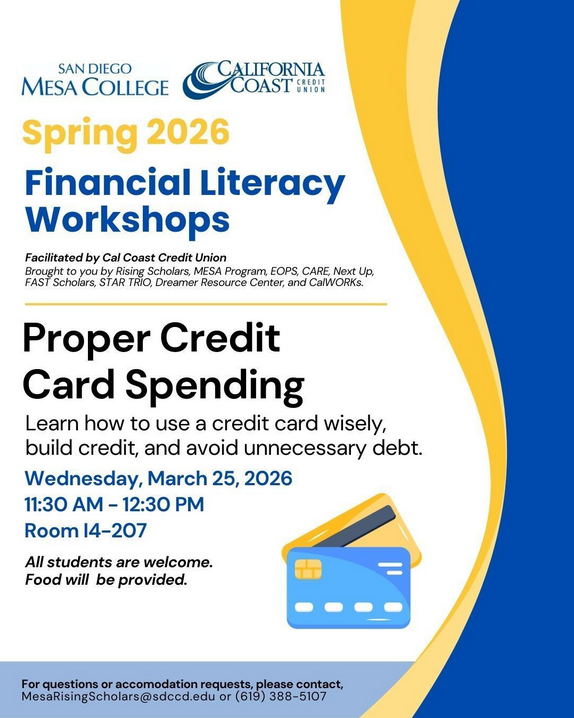
At the financial literacy workshop held by the California Coast Credit Union on March 25, students learned strategies to navigate their payments and decisions. Taralyn Rose, a financial coach with 25 years of experience in credit union and banking, spoke about how everyday financial choices can shape long-term stability.
Financial stress has become a growing consideration in college life as students deal with debt and rising prices. Managing a budget for necessities can be difficult without understanding proper spending habits. Financial literacy can help students with independent life.
Rose spoke about balancing tuition, rent, and jobs. She explained that lack of knowledge in credit scores and credit building plays a major role in future opportunities, such as renting apartments or qualifying for a student loan. While payment history is crucial in maintaining credit scores, students do not need to carry a balance to build credit.
“These small, consistent contributions can grow over time,” she said, “For long-term planning, it’s important to look at investing early.” When money is invested at a young age, the compound interest can provide more money than if they start later. Rose emphasizes that it’s not too late for students to invest now, and even a small investment would be sufficient.
Along with investing, students are encouraged to examine their spending habits and align them with their goals. Impulse spending and subscriptions are common among college students. Tracking expenses through notes or apps can help people be more aware of whether each purchase is necessary or beneficial.
Rose also warns of buy now, pay later services. “These installment apps are one of the worst culprits of unnecessary purchases,” she said, “It’s allowing you to spend money you haven’t actually earned yet. If you see that option, turn away.” It is easy for students to lose track of their cash flow with multiple installment plans.
Students can get further help with maintaining steady expenses with California Coast Credit Union’s Enrich platform for budgeting tools and resources. It includes interactive modules and tools for tracking financial goals, so students who are still unsure can navigate the platform.
Outside of the financial literacy workshop, the credit union offers free one-on-one financial coaching. If students have specific questions or want to speak to someone, they can connect with someone from the website or at a California Coast Credit Union location.
Rose is one of the few coaches available at Mesa, but she takes online appointments and meetings. “I wish I had known this information when I was a student,” she said, “Starting earlier gives you peace of mind for the future, and I hope to see students taking advantage of the resources Mesa provides.”